
If you’re missing multiple teeth, you already know the impact. You’ve adjusted how you eat, learned to avoid certain foods, and stopped smiling in photos. Maybe you’ve noticed your face changing shape, or your denture no longer fits.
You’ve probably heard about dental implants. You may have also heard about implant-supported dentures, All-On-X, and other options. For patients missing multiple teeth, the outcome depends less on the procedure you choose and more on how it’s planned and coordinated. That coordination is difficult when your surgeon and restorative dentist are in different buildings, working from different records, with different people answering the phone.
At Premier Dental Care & Implant Centers, they’re in the same building. Dr. Robert Sharobiem, a board-certified oral and maxillofacial surgeon, and Dr. Karim Naguib or Dr. Marina Salib, who design and place the final restoration, work together on the same plan. We know what matters for patients in Lancaster, Palmdale, and the Antelope Valley.
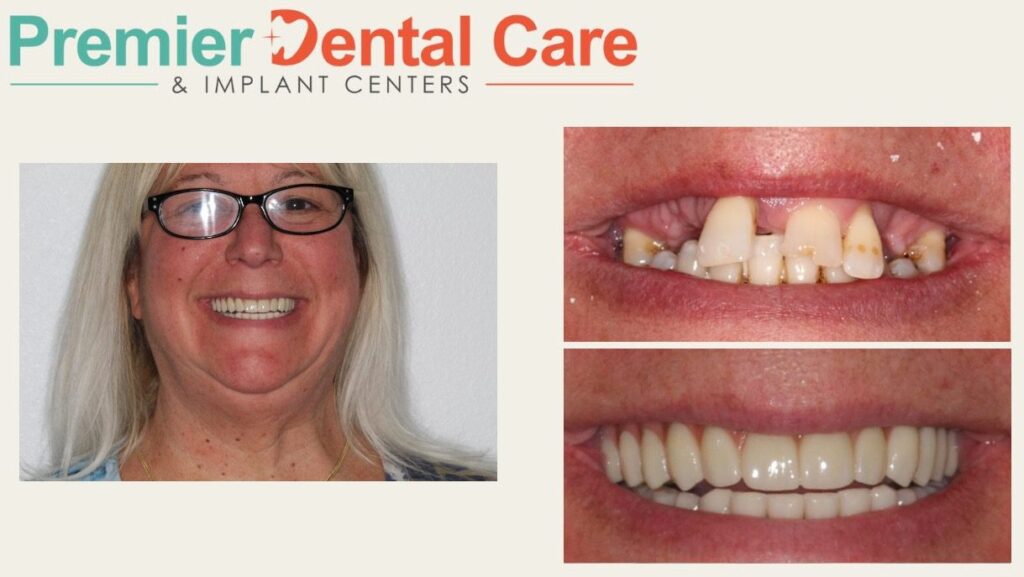
The Two Halves of a Multi-Tooth Implant Case
Replacing multiple missing teeth with implants isn’t one procedure. It’s two, performed by two different skill sets.
The surgical half is placing the implant posts in the jawbone. This requires training in bone anatomy, soft tissue management, and the surgical techniques that make implants integrate successfully. Complex cases also require training in bone grafting, sinus lifts, and complication management. That’s what Dr. Sharobiem brings.
The restorative half is designing and placing the teeth that sit on top of the implants. This requires training in bite function, esthetics, and the way the restoration will look, feel, and function for decades. That’s what Dr. Naguib and Dr. Salib bring.
When those two halves are planned separately, details get lost. The implant may go in at an angle that’s healthy but not ideal for the final teeth. The restoration may need extra adjustments. Or worse, the implants may be placed in a way that limits the type of restoration you can have.
When they’re planned together, in the same building, with the same records, the implant goes in where the restoration needs it. The restoration is designed for the implants that are actually there. The result is more predictable, more comfortable, and more likely to last.
Why Dr. Sharobiem’s Credentials Matter
Not every dentist who places implants is a surgeon, but Dr. Sharobiem is.
He earned his DDS at UCLA in 2009, ranking in the top 5% of his class. He then completed his residency in Oral and Maxillofacial Surgery at St. Barnabas Hospital in New York, where he won the Oral and Maxillofacial Surgery Resident of the Year award. Dr. Sharobiem then earned his Oral and Maxillofacial Surgery Certificate at Mount Sinai Hospital in New York, where he received additional training in reconstruction, oral surgery, and facial trauma.
Dr. Sharobiem is certified by the American Board of Oral and Maxillofacial Surgery. That’s the highest level of credentialing in the field. It requires years of training, a rigorous exam, and a commitment to ongoing education.
He is also one of the founders of the UCLA Oral and Maxillofacial Surgery Study Club and the director of the UCLA/USC Mobile Dental Clinic. He has traveled to Guatemala, Haiti, and Mexico on dental missions to help people experiencing poverty. For that work, the American Association of Oral and Maxillofacial Surgeons awarded him the 2013 Humanitarian Award for Residents.
For patients with multiple missing teeth, that level of training and experience matters. Complex cases aren’t just about placing implants. They’re about evaluating bone, managing soft tissue, planning long-term, and knowing when a different approach is safer.
Why Dr. Naguib and Dr. Salib’s Restorative Expertise Matters
The other half of the equation is just as important.
Dr. Karim Naguib earned his DDS with honors in 2003 and completed a general practice residency from 2004 to 2005. He has over 20 years of experience in general, cosmetic, and restorative dentistry, and he provides in-office surgical and root canal treatments. He’s a member of the Academy of Implant Dentistry.
Dr. Marina Salib graduated from Rutgers School of Dental Medicine, where she was recognized as one of the top students in her class and inducted into the OKU National Dental Honor Society. She completed her GPR at Hackensack University Medical Center and has advanced training in esthetics, same-day crowns and bridges, endodontics, oral surgery, pediatric dentistry, and implant dentistry. She’s a member of the American Academy of Implant Dentistry, the American Academy of Cosmetic Dentistry, and the ADA.
Together, they design restorations that work for the patient’s bite, face, and goals. For multi-tooth cases, that might be an implant-supported bridge, an implant-supported denture, or an All-On-X full-arch restoration. The right choice depends on how many teeth are missing, where they’re missing, and what the patient wants the result to look like.
Because they work in the same practice as Dr. Sharobiem, they can plan the restoration before he places the implants. That changes the outcome.
The Fragmented Alternative
The fragmented model is the more common experience for Antelope Valley patients. You see an oral surgeon for the implant placement. The surgeon does the surgery and sends you back to your general dentist for the restoration.
Your general dentist designs the teeth based on a single X-ray and a brief note from the surgeon. The two never speak, and the records don’t sync. They design the restoration after the implants are placed, and if something is off, you make the phone calls to sort it out.
That model can work. Many patients have successful implant restorations through a fragmented process, but it introduces risk and stress that a coordinated model eliminates.
At Premier Dental Care & Implant Centers, the surgeon and the restorative dentist review the same imaging, plan the case together, and check in with each other throughout. When something needs adjusting, they adjust it. When a patient has a question, they call one number and talk to people who know their case.
What Multi-Tooth Replacement Options Look Like
For patients missing multiple teeth, several options are available. Here’s a quick overview:
- Implant-supported bridges replace missing teeth using implants as anchors. They’re a good option when the missing teeth are in a row, and the surrounding bone is healthy.
- Implant-supported dentures (sometimes called overdentures) are removable dentures that snap onto implant posts. They’re more stable than traditional dentures, and they can be removed for cleaning.
- All-On-X (sometimes called All-On-4 or All-On-6) uses four to six implants to support a full arch of fixed teeth. The teeth are attached to the implants and can’t be removed. This is the most comprehensive option for patients missing most or all of their teeth.
- Traditional dentures are an option when implants aren’t appropriate or when a patient prefers a removable appliance. They’re less stable and don’t prevent bone loss, but they’re less expensive and less invasive.
Dr. Sharobiem, Dr. Naguib, and Dr. Salib will evaluate your case and explain which option best fits your health, goals, and budget. To learn more about your dental implant options, Visit:
- Dental Implants in Palmdale & Lancaster
- All-On-X Implants
- Benefits of Dental Implants
- Bone Grafting
- Dental Implant Process
- Multiple Dental Implants
- Single Tooth Implants
What the Process Looks Like
For a multi-tooth implant case at our practice, the process typically follows these steps:
- Consultation and Imaging. Dr. Sharobiem evaluates your bone, gum health, and overall health. Dr. Naguib or Dr. Salib evaluates your bite, your cosmetic goals, and the restoration options.
- Treatment Planning: The team reviews the case together and coordinates the surgery and restoration plan.
- Surgical Placement: Dr. Sharobiem places the implants. For complex cases, the team may need bone grafting or other procedures first. Sedation is available.
- Healing: The implants integrate with the bone over three to six months. A temporary restoration keeps you comfortable during this time.
- Final Restoration: Dr. Naguib or Dr. Salib places the final restoration. It’s designed to fit your bite, look natural, and function for years.
- Follow-up: We check in to make sure the implants and the restoration are working as they should.
Where to Find Us
Our offices are in Lancaster, East Palmdale, and West Palmdale. We serve patients from Lancaster, Palmdale, Quartz Hill, Rosamond, Mojave, Littlerock, and throughout the Antelope Valley.
If you’re missing multiple teeth and you’re weighing your options, call us at (661) 231-7157 for Lancaster, (661) 231-7031 for East Palmdale, or (661) 605-3714 for West Palmdale. You can also request an appointment online anytime.
Replacing multiple teeth is a significant investment. Getting the plan right from the beginning is what makes that investment last. Having a board-certified surgeon and an experienced restorative team in the same building helps ensure the plan is right.